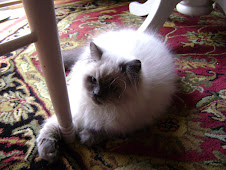
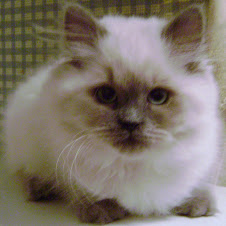
Some say that Love and 'Being Needed' are two different matters entirely and that there is something wrong fundamentally with a person who equates the two. Even so, part of a Mother's Love is the knowledge that she is needed to keep her child alive, and this is the case whether the 'child' is human or belongs to a different species.
There are those who make spurious arguments to the effect that a person who herself needs aid in some matters or who has very little money has no right to take on the responsibility of caring for another creature but often that kind of responsibility is the very cornerstone of strength and hope for the poor and the disabled. A cat or dog can be a great source of strength and in caring for another, a person who may feel impotent or helpless because of society's judgements may become empowered.
In any event, for whatever reason, part of my 'raison d'etre' is caring for my Cats. When the physical pain in which I live becomes almost intolerable, the necessity to care for my Cats actually spurs me on and makes me determined to continue to withstand pain and its servant, Despair.
Although I adore kittens, I have discovered that a more profound relationship exists with older Cats, those who have been your Companions since they were kittens. A Kitten needs care and can amuse his/her caretaker vastly, but Cats never lose their kittenish mischief and curiosity.
Of my two Cats, Beauty is the most vocal and the most demanding but it is as an inseparable pair that they turn their world upside down on occasion. I've had trouble with them in terms of their food since their infancy. As soon as they had the physical strength to do so, they began to turn their food dishese upside down, dumping the contents on the floor. A good friend solved the problem by sending me a very sturdy and rather wonderful wooden 'feeding station' in which two dishes would be set. Rather than giving a dish to each Cat (as the two names on the front of the wooden station indicated, I chose to designate one for food and one for water.
A year later, I have come to the realisation finally that they do not like bowls for whatever reason. What I construed as mischief was their desire to eat from a flat surface. These two were not born in my care. They came to me at three months of age, with many habits formed. Whatever the reason, they do not like to eat or drink from a bowl. I daresay they would prefer to drink their water from a flat surface, although that would create a mess akin to the Great Flood.
Humans, for all of our delusions of intellectual superiority, can be dense. Why did it take me a year to decipher their actions??? Anyway, I now give them the wet food on a plate. Even with that compromise, they tend to push it off the plate onto the floor every day. I do give it to them in small enough quantitites that they usually polish it off the floor as well as the plate within a half an hour. I have to keep the floor spotless, obviously... Next, I am going to try a larger platter, but I expect that what will occur is that the food in the centre of the platter will be ignored, making that change counterproductive.
For dry food and water, I still use the wonderful wooden feeding station. I had no trouble with that until this morning.
The cooler weather evidently has increased their energy and potential for mischief. Each morning, I find their bedding all over the place and half of their toys in the litter boxes. What was new this morning was the disappearance of the water bowl from the feeding station!
Amazingly, one or both of them had removed it from the rather high wooden setting and absconded with it. I found it finally on the other side of the room. I expect that they took it from its place after drinking all the water. It was dry and empty and I found no pools of water anywhere.
What does this have to do with Love? Only the incredible sense of warmth in my breast when I think about them, whether it is their faithful morning ritual of washing MY face and hands or their antics. My Life would be insufferable without a Cat.
When I was a child, I never was allowed to keep a Cat. To me, given that deprivation, it is amazing that I learned how to love at all or how to take responsibility for the welfare of any other being. Children usually beg for pets, then break every promise to their parents that deals with care and responsibility. I daresay that is why my Mum never allowed me to keep a Cat, but I firmly believe that she was wrong to do so. Even when the parent is forced to shoulder the burden of caring for the child's pet, it teaches the child HOW to care for another and widens that child's universe immensely. Children who never had pets easily fall into subscription to the erroneous philosophy that human beings are the only creatures who matter on this planet. Any Child who has loved a pet knows the truth, that our 'superiority' exists only in certain areas and that we definitely are inferior in others.
Religions often declare that human beings were designated as 'Lords of the Earth', but to me, that is no more than an attempt at self-justification for the exploitation of others. If, however, we are the 'Lords of our Earth', then we have the duty to care for and protect other species. An axiom of ancient common law:
'Qui sentit commodum, debet et sentire onus.' Translation: Who knows a benefit should know a burden as well. If we are Lords of our planet, then we are its Guardians and a Guardian has the burden of acting in the best interests of all. In fact, a Guardian is NOT an Owner. He/she is merely a caretaker. It is the ultimate 'sacred Trust'.
Even in the Islamic Qur'an, there is a verse that refers to humanity as 'lords of the Earth' but makes it clear that we have only guardianship over all living things.
Showing posts with label Cats. Show all posts
Showing posts with label Cats. Show all posts
Monday, November 9, 2009

Sunday, March 15, 2009
The Cats of Cadiz


When I visited Pompeii, it was the domain of a colony of wild dogs. They were 'wild' only in the sense of being feral. They exhibited no trace of hostility but it was a very large colony and one couldn't find any area in the ruins without one or two dogs and sometimes more. I do not know if people really are divided between cat lovers and dog lovers. There are many who love both equally. I definitely find cats more to my taste and therefore was delighted to find a colony of cats inhabiting the rocky beach at Cadiz.
They may have been feral, but they definitely depended on human servants for their sustenance. Small bowls filled with food and fresh water were placed in numerous niches in the rocks, almost like offerings to household gods. It reminded me of the extraordinary position cats have occupied throughout history, often either revered as gods or messengers of the gods or feared and persecuted as agents of evil. Dogs in general have not suffered from the same bias, although their Wolf cousins have attracted strong prejudice and the same kind of powerful mystique as cats.
Many animal lovers sense a relationship of some kind between their animals and the Divine. A close friend of mine confessed once that he believed one of his cats actually communicated with the otherworld regularly and referred to him as his Shaman. I have felt the same on occasion. How often has a cat's attention been held by something invisible to its owner? Even their ability to invent games using the unlikeliest objects sets them apart from the ordinary. A cat never loses the ability to experience childlike wonder and excitement. In many ancient cultures, gods were depicted as having the same ability.
For the most part, the natives of Cadiz probably leave food and water for the wild cats of the beach simply out of kindness but I would imagine there may be an old tradition somewhere linking good fortune to their presence at the shore...
Cleanliness, Godliness and Cats
There is an old proverb that most children probably learn to hate to the effect that 'Cleanliness is next to Godliness'. Cats, once worshipped as gods in more than one ancient culture certainly are devoted to Cleanliness far more than humans ever have been even in their 'wild' state.
Cats are not entirely content if they are not clean. Furthermore, they prefer a clean environment. That is why a cat can be trained quite easily usually to use a litter box. Even cats who are not 'litter-trained' will attempt often to cover their messes. Some may argue that this is not so much an example of cleanliness as it is concealment of the cat's presence from potential enemies. The habit of covering any mess is only one example of a cat's fastidious nature.
Contrary to popular belief, cats actually love to be bathed once they have learned to accept water as a familiar medium. If they trust the person who is giving the bath and are familiar with the sensation of being bathed, they actually can learn to enjoy the ritual. They definitely like the result.
When a cat 'scratches' a post or any wooden object, the cat does not sharpen his/her nails as much as he/she grooms the nails by performing this action. Dead nail is removed when a cat scratches a post. Cats need nail grooming and again, once a cat is familiar with the process and learns to trust the implement, a cat will be happy to have his/her nails clipped by an owner. The best way to do this, in my experience is by massaging the cat's paws. Rub the centre of the ball of the paw and a cat will stretch contentedly, responding positively to the massage. Once a cat becomes familiar with this ritual, the clippers can be introduced and you will find it is not that difficult to clip the nails. As when clipping the nails of a child, however, one must be alert and careful not to cut the nail to the quick.
More essential than bathing or nail grooming, however is the ritual of combing. A healthy, contented cat will spend hours washing himself/herself and any feline companions. When a cat owner combs a cat, he/she is entering into the cat community in a ritual that is an essential part of a cat's life.
A cat will groom another cat's fur as an act of friendship and love. When an owner combs a cat, this is recognised more as an act of love than any verbal dialogue ever would be.
Even short-haired cats appreciate combing, but for a long-haired cat, it is absolutely essential. Cats may be skittish at first at the touch of the comb, but they quickly learn to enjoy the ritual and it is a far more effective way of removing dead fur and stimulating the scalp than any other. When an owner combs his/her cat regularly, the cat will not swallow hairballs as all the dead fur will have been removed previously by the comb.
Some cat owners are reduced to the measure of taking a cat to a veterinarian to be shaved once or twice each year after the cat's fur becomes so matted as to be intolerable. This should not be necessary in the case of even a cat with extremely long hair. Combing the cat twice weekly would prevent fur from becoming matted and both owner and cat would benefit from the ritual.
The cat may benefit physically from regular combing, but the owner can benefit emotionally and spiritually. Brushing or combing hair is an ancient rite of magic. The rhythm of the brush or comb is conducive to meditation and alters breathing patterns and spiritual focus. It reduces stress and forces the individual to detach himself/herself from all other aspects of life. When this ritual is conducted with a beloved pet, it benefits both the animal and the owner. Moreover, it is an act of bonding and the animal will respond accordingly.
Adult cats who never have been combed can learn to enjoy it as much as a cat who has been combed from infancy. I have been able to persuade feral cats to accept a combing and to learn to relax with the comb. I actually prefer a 'flea comb' to other brushes and combs because it has very fine teeth and can be used to undo the worst 'knots' in a cat's pelt. When I find a knot, I then use the corner of the comb to tease it out gently and slowly. It is very effective.
Initially, I had intended to write only about the sense of peace that descends upon me whenever I comb a cat, but when I realised how many cat owners and cat lovers never have combed their cats, I decided to write about combing and grooming in general.
I have had more than one cat who has reciprocated. I find it quite charming when a cat decides to groom me. To me, that is the final proof that, to a cat, grooming is an act of love and acceptance and one that is an essential part of his/her existence.
I do not believe that human beings necessarily are superior to other forms of life. Although we may be more technologically advanced in certain areas, in other areas we can learn from animals as much as our ancestors did. The argument that animals act only according to instinct is as fallacious as any contention that human acts are governed solely by instinct. On the other hand, the instinctive behaviour patterns of our animals can be applied to our own lives to improve both our understanding of our pets and our own spiritual standard of living.
As far as I am concerned, it is obvious that cats are superior to us in their ability to relax. A cat can immerse himself or herself wholly in the act of contemplation or meditation yet still be alert for danger on another fundamental level. Contemporary society is fast-paced and many people find it difficult to relax. In fact, the inability to relax is at the heart of many psychological and physical disorders. The simple ritual of combing a pet can provide a key to relaxation. In ancient societies, individuals actually would study animal behaviour as a spiritual exercise. Although our urbanised life makes it difficult for us to interact with many animals firsthand, household pets still provide a link with the animal kingdom that should not be underestimated or ignored.
Feeding a pet is only one aspect of care and attention. As when raising a child, it is not sufficient simply to provide shelter and physical sustenance. In the role of parent, owner or caretaker, one can receive knowledge and love as well as give it. The joys of having a pet, as much as the joys of having a child, far outweigh the burdens.
Cats are not entirely content if they are not clean. Furthermore, they prefer a clean environment. That is why a cat can be trained quite easily usually to use a litter box. Even cats who are not 'litter-trained' will attempt often to cover their messes. Some may argue that this is not so much an example of cleanliness as it is concealment of the cat's presence from potential enemies. The habit of covering any mess is only one example of a cat's fastidious nature.
Contrary to popular belief, cats actually love to be bathed once they have learned to accept water as a familiar medium. If they trust the person who is giving the bath and are familiar with the sensation of being bathed, they actually can learn to enjoy the ritual. They definitely like the result.
When a cat 'scratches' a post or any wooden object, the cat does not sharpen his/her nails as much as he/she grooms the nails by performing this action. Dead nail is removed when a cat scratches a post. Cats need nail grooming and again, once a cat is familiar with the process and learns to trust the implement, a cat will be happy to have his/her nails clipped by an owner. The best way to do this, in my experience is by massaging the cat's paws. Rub the centre of the ball of the paw and a cat will stretch contentedly, responding positively to the massage. Once a cat becomes familiar with this ritual, the clippers can be introduced and you will find it is not that difficult to clip the nails. As when clipping the nails of a child, however, one must be alert and careful not to cut the nail to the quick.
More essential than bathing or nail grooming, however is the ritual of combing. A healthy, contented cat will spend hours washing himself/herself and any feline companions. When a cat owner combs a cat, he/she is entering into the cat community in a ritual that is an essential part of a cat's life.
A cat will groom another cat's fur as an act of friendship and love. When an owner combs a cat, this is recognised more as an act of love than any verbal dialogue ever would be.
Even short-haired cats appreciate combing, but for a long-haired cat, it is absolutely essential. Cats may be skittish at first at the touch of the comb, but they quickly learn to enjoy the ritual and it is a far more effective way of removing dead fur and stimulating the scalp than any other. When an owner combs his/her cat regularly, the cat will not swallow hairballs as all the dead fur will have been removed previously by the comb.
Some cat owners are reduced to the measure of taking a cat to a veterinarian to be shaved once or twice each year after the cat's fur becomes so matted as to be intolerable. This should not be necessary in the case of even a cat with extremely long hair. Combing the cat twice weekly would prevent fur from becoming matted and both owner and cat would benefit from the ritual.
The cat may benefit physically from regular combing, but the owner can benefit emotionally and spiritually. Brushing or combing hair is an ancient rite of magic. The rhythm of the brush or comb is conducive to meditation and alters breathing patterns and spiritual focus. It reduces stress and forces the individual to detach himself/herself from all other aspects of life. When this ritual is conducted with a beloved pet, it benefits both the animal and the owner. Moreover, it is an act of bonding and the animal will respond accordingly.
Adult cats who never have been combed can learn to enjoy it as much as a cat who has been combed from infancy. I have been able to persuade feral cats to accept a combing and to learn to relax with the comb. I actually prefer a 'flea comb' to other brushes and combs because it has very fine teeth and can be used to undo the worst 'knots' in a cat's pelt. When I find a knot, I then use the corner of the comb to tease it out gently and slowly. It is very effective.
Initially, I had intended to write only about the sense of peace that descends upon me whenever I comb a cat, but when I realised how many cat owners and cat lovers never have combed their cats, I decided to write about combing and grooming in general.
I have had more than one cat who has reciprocated. I find it quite charming when a cat decides to groom me. To me, that is the final proof that, to a cat, grooming is an act of love and acceptance and one that is an essential part of his/her existence.
I do not believe that human beings necessarily are superior to other forms of life. Although we may be more technologically advanced in certain areas, in other areas we can learn from animals as much as our ancestors did. The argument that animals act only according to instinct is as fallacious as any contention that human acts are governed solely by instinct. On the other hand, the instinctive behaviour patterns of our animals can be applied to our own lives to improve both our understanding of our pets and our own spiritual standard of living.
As far as I am concerned, it is obvious that cats are superior to us in their ability to relax. A cat can immerse himself or herself wholly in the act of contemplation or meditation yet still be alert for danger on another fundamental level. Contemporary society is fast-paced and many people find it difficult to relax. In fact, the inability to relax is at the heart of many psychological and physical disorders. The simple ritual of combing a pet can provide a key to relaxation. In ancient societies, individuals actually would study animal behaviour as a spiritual exercise. Although our urbanised life makes it difficult for us to interact with many animals firsthand, household pets still provide a link with the animal kingdom that should not be underestimated or ignored.
Feeding a pet is only one aspect of care and attention. As when raising a child, it is not sufficient simply to provide shelter and physical sustenance. In the role of parent, owner or caretaker, one can receive knowledge and love as well as give it. The joys of having a pet, as much as the joys of having a child, far outweigh the burdens.
Subscribe to:
Posts (Atom)