Tuesday, September 22, 2009

Caring for Newborn Kittens


**********************************************************

When a litter is born and the mother is incapable or unwilling to nurse her kittens, a surrogate mother sometimes can be successful in keeping them alive. In other cases, where the infants are not developed fully, the results will not be successful.

Cats are very loving creatures and if you have another female in your home with kittens, she usually can be persuaded to nurse any kittens (or indeed animals of other species) as well as her own. For example, there are countless cases of queens who have adopted a orphaned puppy.

Unfortunately, purebred cats tend to be more fragile than mixed breeds and a first litter for a young purebred cat can be a tragedy. Professional breeders therefore often separate their males and females until the female is older. If one has only two cats who are deeply devoted to one another, it might be too cruel to separate them.

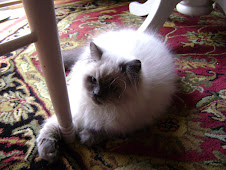
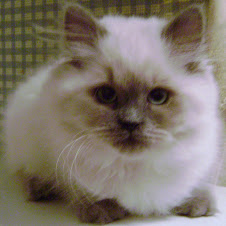
In the case of Beauty, she and Ashleigh are extremely close to the point where one cannot be out of sight of the other without crying. When she went into heat for the first time, he appeared to be utterly indifferent to this new development and showed absolutely no signs of knowing how to take affirmative action. Beauty showed no signs of pregnancy afterwards. I was utterly shocked when she went into labour. Having celebrated her first birthday in June, if she had not been a purebred, she probably would have had little trouble in delivering a healthy litter, although first litters tend to be smaller than subsequent ones. She is a purebred, however, and her labour lasted three days. Amazingly, she showed little distress during this lengthy and prolonged ordeal, although she understandably was more dependent on me than usual. Ashleigh was paralysed with terror by the entire business and would not even approach the kittens. As he is a large cat, his cowardly attitude, although not unusual in Himalayans, is almost comical but of course, when a child exhibits fear, even if the 'child' is a cat, one can't laugh at that genuine emotion, however unmerited the fear may be.

Two kittens were stillborn, one of which was extremely premature. Of the other two, both were premature but fully formed, at least outwardly. They did not breathe easily, however, even at birth, although they were able to cry and thrash about a little.

What further confused me initially was Beauty's odd behaviour where nursing was concerned. She would facilitate it by rolling into position and welcoming the kittens but as soon as a kitten approached a nipple, she would move out of reach and then walk away. Later, I came to realise that this was due to the fact that her labour had not ended. Obviously, contractions were encouraged by any stimulation in that general area. Once I realised that, I massaged her stomach frequently throughout the long weekend. At the same time, I took on the responsibility of feeding the two live kittens myself. Unfortunately, between the birth and the realisation that Beauty actually was not nursing the kittens properly, some time had elapsed as in the beginning, she would assume a nursing position and the kittens then would be comforted and no longer cry.

Tube feeding would have been the optimum solution although I have tube fed premature kittens in similar circumstances who ultimately died. Other kittens I have tube-fed, including one with a cleft palate, lived and thrived.

Since my accident in June, however, I have had neither transportation nor good physical mobility. Furthermore,the automobile accident has proven very costly. The fact that the delivery of the kittens coincided with a weekend made the situation more complicated. One could not simply toss them into the lap of a veterinary clinic, thereby delegating responsibility both for life and death.

With some KMR on the way but not yet in sight, I looked for a good recipe for formula using common household ingredients.

There apparently is a formula commonly known as 'Kitten Glop'. I found a number of recipes for this.

In the past, I created a formula for kittens who had to be fed using the following:

evaporated milk or KMR
purified water
infant 'chicken' or 'turkey' commercial baby food

I mixed these together to form a thin liquid and then fed it to the kittens using a feeding syringe or feeding tube if the kitten were unable or unwilling to swallow.

The 'Kitten Glop' includes more ingredients, however:

glucose in the form of corn syrup
plain yoghurt
'Pedialyte', a liquid for human infants that provides energy and nutrients
mayonnaise
beaten egg yolk (but can be dangerous because of salmonella)

If you can persuade the kitten to stay in a position close to an ordinary nursing position, on his/her stomach, so that it can 'knead' with its little paws, that is best, but the main goal is to get the food into it. (I am using 'it' for simplicity only.) Make certain that the syringe or tube is clear of air bubbles and feed the mixture to the kitten very slowly. Whether you use the syringe by itself or with the tube attached to it, this can be difficult as the plunger will begin to stick, especially if you use the same syringe more than once. You have to be very careful and very patient... If bubbles come from the kittens nose, you are feeding him/her too quickly.

A healthy kitten will use its tongue a little and you will see it swallow but when a kitten begins to 'shut down', often it will not swallow any longer. Tube feeding may revive it or it may not do so.

The beauty of tube-feeding is that it does not require a kitten's active participation. Very often a premature or weak kitten will lose the will to fight. Tube-feeding overcomes this by directing the food into the stomach. There are dangers, however.

To prepare the tube, lay it against the kitten and measure to the last rib, making certain that you wrap a piece of tape or something else that will allow you to 'save' that point on the tube for reference. You should never insert the tube beyond that point when feeding the kitten. Insert the tube very slowly and gently, never forcing it if it does not move effortlessly, and never insert it beyond the point you have marked.

Make certain, whether feeding with syringe only or with tube and syringe that your mixture is warm, but not hot. A little warmer than room temperature will imitate the queen's milk best. Cold formula is nasty and does not sit well in the kitten's digestive system, nor will it appeal much to a kitten who can swallow voluntarily.

When you warm the milk, a microwave can be dangerous as it does not heat all of the liquid consistently. If you use one, stir the liquid well afterwards and test it with your wrist or finger the way you would test baby formula for a human infant.

Warmth is essential, not only with respect to the food but to the kitten's environment. If your Queen will stay with her kittens, even while not actively nursing them, this is best. Kittens instinctively wish to be close to their mothers and I believe that they gain spiritual strength from that contact as well as physical comfort. If the Mother cannot settle with her kittens, however, the situation may vary according to the number of kittens in the litter. If you have a large litter of six or more kittens, they can pile together for warmth in a box that is lined with warm materials (but make certain that a kitten cannot be 'lost' in the fabrics to suffocate). If you have pieces of genuine or synthetic fur, that would be even better, retaining warmth and simulating the real mother's body. If there are only one or two kittens, it may make sense to assume total control of them, especially if the Queen will not remain with them. You then should use a heating pad beneath the fur/fabric in the box to keep the kitten warm.

In Beauty's case, the kittens became very cold at one point because I did not realise that she would not stay with them and that she was NOT nursing them. This would not have occurred if I had taken them from her immediately but she appeared to want them and she always went into the proper nursing position and took an interest in them temporarily.

Kittens will respond to warmth. Try not to wrap them in fabric that can cause danger of stifling them and if you use a heating pad, make certain that there is fabric on it, and that the setting is low, and will not burn the little creatures.

There is one other area where your services will be required. You need a warm wet cloth to stimulate the kitten's nether regions after each feeding. A Mother Cat will use her tongue to stimulate her kittens to eliminate... if she cannot or will not do this, you must do it for her, not with your tongue of course, but with a warm wet flannel. Be gentle and use only soft materials as you will have to do this a few times every day. If the area becomes red and sore, you can use a little petroleum jelly, again as you would for diaper rash.

If you are placed in care of the life of a newborn kitten, you should feed him/her at least six times per day, both during the day and the night but do not overfeed. The kitten's tummy should be plump and yet still soft after feeding, never distended or hard. It is safer to underfeed a little with each feeding than to overfeed.

The bonding that occurs between a surrogate human mother and newborn kittens who require sustenance is incredibly strong and rewarding if the kitten survives. If the kittens do not survive, the pain of loss may be tremendous but I believe it always is better to fight for their lives than to simply shrug and leave it to fate.

One final point should be made here. In a situation where you have newborn kittens, their mother and another cat or cats, you must take care not to neglect the 'other cat/cats' during the 'emergency' period. Unlike Beauty and her babies, Ashleigh was in no physical danger, but his entire universe was turned upside down. He is not a courageous or adventurous cat by nature. The introduction of this drama into his life was very unsettling for him. I tried to remember to pet him and speak to him even when consumed with worry for Beauty and the kittens.

Once I had a male chocolate point Himalayan nicknamed 'Pi' who was extraordinary in that HE would adopt any creature who appeared to need comfort, including newborn kittens. When my bluepoint female, Isis, became to weak to nurse her litter of six shortly after delivery, I had to take her into hospital. During the week she stayed in hospital, I fed her six babies myself. That was an enormous task, as each time I finished feeding the last of the six, the first would be ready to be fed again.

The amazing thing was Pi's response in this situation. He promptly moved into the box with the kittens and went into a 'nursing' position. He had no milk, of course, but he gave them warmth and comfort. He was not even the father, incidentally, but he acted as both mother and father to these kittens inasmuch as he cuddled them and licked them clean after each feeding.

Incidentally, the entire litter survived and thrived. Isis, when she came back from hospital, still could not nurse her babies but she would spend time with them, when Pi allowed her to do so.

Poor Ashleigh, who IS the father of Beauty's kittens, could not even go near them. Gazing up at me in absolute panic with his huge blue eyes, I felt bad for him, knowing he was entirely out of his depth.

One fact about cats or any other pet is that each one is different. You cannot expect the same responses from every cat you have. Some females are natural mothers but others are not.

The first two Himalayan females I had were a sealpoint and a bluepoint. They both had kittens on the same day. Anastasia was a natural mother. She created a nest for herself and proceeded to have her kittens one by one, cleaning them thoroughly then settling to nurse them. Princess, on the other hand, wouldn't make a nest, nor would she look at the nest I made her. She leapt onto my bed and had her kitten in my lap. I had to clean the the little boy, cut the cord and deal with the afterbirth. When I firmly placed her and the kitten in the nest I had made, she promptly grabbed him by the scruff of the neck and deposited him in my lap again! She had no intention of assuming ANY responsibility for her child.

It was Anastasia who noticed the new kitten and who became agitated by its cries. She left her own kittens to find the kitten on the bed. She then took him by the scruff of the neck, leapt off the bed and deposited him in the box with her own kittens. All of the babies prospered in Tasie's care, but Princess never showed the slightest interest in ANY of them.

People who think of cats as being 'cold' have no real knowledge of the species. My cats always have been very sensitive where my own moods are concerned. If I am in pain or upset, they try to comfort me. They are far more aware instinctively than many humans.

Cats can be very selfless as well. When Isis' kittens grew old enough to eat proper food, she would stand aside until each had eaten his/her fill. No matter how hungry she might be, she never would touch the food until every one else had eaten. Mind you, I never let them become REALLY hungry, but it was the same when I offered treats. She would wait until the kittens had been satisfied and only then would accept a treat from me.

Photograph of Friendship, consort of Isis and father of her Kittens. He was rather small and delicate in appearance but quite a stud!

Saturday, September 19, 2009

Update on Beauty


********************************************************

Poor Beauty. She showed no signs of pregnancy and yet delivered not two but four kittens over a period of twenty-four hours. Two were stillborn and one of the stillborn kittens was a breech birth. The first kitten was stillborn. The second was a white male who probably would be a bluepoint if, by some miracle, he were to survive. He may have had a better chance of it had Beauty not been in terrible distress.

Refusing to settle, she paid him little attention. I finally found an old shirt with a pocket and placed him inside. By then, however, he was chilled and weak.

Meanwhile, I could feel that something remained inside her womb, so I massaged her unntil she finally began contractions again. The reason for the delay and the difficulty soon became apparent. The kitten, very premature and clearly dead, was in the breech position. It took over half an hour to resolve the situation.

Beauty then relaxed and I decided to let the single little live kitten be with his mother at the end. He had voided the warm milk and water mixture I had given him. I did not think he would survive the night. In fact, at one point I had thought him dead but then was able to discern the slightest movement from him.

An hour later, though, to my shock, I found him alone on the floor, extremely active, crying loudly. I then saw him motionless about a yard away... Beauty had given birth to another baby! This birth evidently was fairly easy and quick as she had not made any sound to alert me.

The first kitten did survive the night but remains very weak and will not swallow unaided. The second live kitten initially could not nurse, but I have been able to feed him a little milk and water. If I hold him to the spot, he will nurse a little. It is my hope that as he grows stronger, he will learn to nurse properly.

I will continue to fight for the life of the first kitten, but it does not look very promising. I am not terribly happy with the 2%milk/water mixture but I am waiting (in vain, I think now) for a delivery of Catmilk.

I cannot place a heating pad at the site as both Beauty and Ashleigh will bite through any electrical cord they can find. I either have to remove the first kitten again from his mother to keep him warm myself or allow him to be with his sibling and intervene only to feed.

Sunday, March 15, 2009

A Tale of Two Bad Kittens


This is nothing more than a little video tribute to the friend who sent the wonderful 'feeding station' that solved an ongoing problem.

Below, a little video I made about the Kittens' first Christmas.


Neither have any particular artistic merit. Like a proud parent who captures images of a child in order to preserve that period in the life of a loved one, these videos were made primarily to remind me of the kittenhood of Ashleigh Attila and Marmee, aka 'Beauty'.

The Cats of Cadiz


When I visited Pompeii, it was the domain of a colony of wild dogs. They were 'wild' only in the sense of being feral. They exhibited no trace of hostility but it was a very large colony and one couldn't find any area in the ruins without one or two dogs and sometimes more. I do not know if people really are divided between cat lovers and dog lovers. There are many who love both equally. I definitely find cats more to my taste and therefore was delighted to find a colony of cats inhabiting the rocky beach at Cadiz.

They may have been feral, but they definitely depended on human servants for their sustenance. Small bowls filled with food and fresh water were placed in numerous niches in the rocks, almost like offerings to household gods. It reminded me of the extraordinary position cats have occupied throughout history, often either revered as gods or messengers of the gods or feared and persecuted as agents of evil. Dogs in general have not suffered from the same bias, although their Wolf cousins have attracted strong prejudice and the same kind of powerful mystique as cats.

Many animal lovers sense a relationship of some kind between their animals and the Divine. A close friend of mine confessed once that he believed one of his cats actually communicated with the otherworld regularly and referred to him as his Shaman. I have felt the same on occasion. How often has a cat's attention been held by something invisible to its owner? Even their ability to invent games using the unlikeliest objects sets them apart from the ordinary. A cat never loses the ability to experience childlike wonder and excitement. In many ancient cultures, gods were depicted as having the same ability.

For the most part, the natives of Cadiz probably leave food and water for the wild cats of the beach simply out of kindness but I would imagine there may be an old tradition somewhere linking good fortune to their presence at the shore...

Injections causing Malignant Tumours in Cats


**********************************************************************************

A few years ago, a mother cat and her son, both jet black, had been abandoned by some one in the neighbourhood and had been reduced to skeletal proportions by their new lifestyle before I discovered them and began to leave food for them outside. For two months, they would eat only if I returned first to the house. It was only in the third month that I was able to stay nearby to watch them eat. A few months after that, I was able to persuade them to come into the house to eat and rest. By then, the mother was pregnant again.

When she was ready to have her kittens, I made a place for her in the house. The new litter was born inside the house and I found homes for all but one. That kitten become our pet, Lionheart. A home was found for the mother as well. Osiris, her eldest son, remained feral and although he would allow me to hold him and pet him, he would not stay inside the house. He would become increasingly distressed if, even in the worst weather, I tried to keep him inside.

Osiris was an uncommonly beautiful black cat with wide green eyes. I loved him dearly and wished that I could persuade him to stay in the house. He had a wild spirit, though, and although he loved to be held and even combed, he always insisted on making his escape after an hour or two.

He was hit by a car one morning at dawn. I grieved for him terribly and still miss him.

This morning, I found a cat outside napping in a nest of leaves. Some one in the neighbourhood owns this cat but allows him to roam outside. Although he does not have Osiris' extraordinary beauty, there is something about him that leads me to suspect that he may be Osiris' son or even grandson. It makes me happy to think of Osiris living on in his progeny, despite the fact that it is 'politically incorrect' to some extent.

This leads me to a danger to cats that can be as fatal as any car collision and can be caused by an act performed in the mistaken belief that it actually is protecting the animal against harm.

In 1991, a discovery was made to the effect that two common feline vaccines actually were responsible for the development of malignant tumours at the site of vaccination. These tumours, called 'fibrosarcomas' were linked to the vaccines for rabies and feline leukemia.

A task force formed to study the problem and make recommendations suggested that the leukemia vaccine should be administered SOLELY to cats who spent time outdoors. The rabies vaccine obviously should be administered only as absolutely required by law.

In any situation, both vaccines never should be given more than once every three years.

Finally, veterinarians were urged to change the site of injection from a site between the shoulder blades to one in the left rear leg near the ankle. The reason for this is that, should a malignant tumour develop at the site, any tumour between the shoulder blades is virtually impossible to remove. In the case of a tumour in the rear leg, amputation of the leg, however undesirable, could save the animal's life.

A paper published in February 2009 by the Journal of the American Veterinary Medical Association indicated that many veterinarians have ignored the recommendations of the task force. Not only have they continued to give these injections too frequently, they have not changed the site of the injection. Consequently, a significant number of cats have developed malignant tumours at an injection site between the shoulder blades.

As a cat lover, I believe it is vital to educate cat owners as to the dangers inherent in this practice. If the professional veterinarian refuses to educate himself/herself as to the risks these injection practices poses, the owner of the cat must be aware of the situation and insist either that the veterinarian not give the leukemia injection if the cat is an indoor pet or if the animal roams outdoors, give the injection only once every three years and use a rear leg for the site rather than placing it between the shoulder blades at an inoperable site.

Cleanliness, Godliness and Cats

There is an old proverb that most children probably learn to hate to the effect that 'Cleanliness is next to Godliness'. Cats, once worshipped as gods in more than one ancient culture certainly are devoted to Cleanliness far more than humans ever have been even in their 'wild' state.

Cats are not entirely content if they are not clean. Furthermore, they prefer a clean environment. That is why a cat can be trained quite easily usually to use a litter box. Even cats who are not 'litter-trained' will attempt often to cover their messes. Some may argue that this is not so much an example of cleanliness as it is concealment of the cat's presence from potential enemies. The habit of covering any mess is only one example of a cat's fastidious nature.

Contrary to popular belief, cats actually love to be bathed once they have learned to accept water as a familiar medium. If they trust the person who is giving the bath and are familiar with the sensation of being bathed, they actually can learn to enjoy the ritual. They definitely like the result.

When a cat 'scratches' a post or any wooden object, the cat does not sharpen his/her nails as much as he/she grooms the nails by performing this action. Dead nail is removed when a cat scratches a post. Cats need nail grooming and again, once a cat is familiar with the process and learns to trust the implement, a cat will be happy to have his/her nails clipped by an owner. The best way to do this, in my experience is by massaging the cat's paws. Rub the centre of the ball of the paw and a cat will stretch contentedly, responding positively to the massage. Once a cat becomes familiar with this ritual, the clippers can be introduced and you will find it is not that difficult to clip the nails. As when clipping the nails of a child, however, one must be alert and careful not to cut the nail to the quick.

More essential than bathing or nail grooming, however is the ritual of combing. A healthy, contented cat will spend hours washing himself/herself and any feline companions. When a cat owner combs a cat, he/she is entering into the cat community in a ritual that is an essential part of a cat's life.

A cat will groom another cat's fur as an act of friendship and love. When an owner combs a cat, this is recognised more as an act of love than any verbal dialogue ever would be.

Even short-haired cats appreciate combing, but for a long-haired cat, it is absolutely essential. Cats may be skittish at first at the touch of the comb, but they quickly learn to enjoy the ritual and it is a far more effective way of removing dead fur and stimulating the scalp than any other. When an owner combs his/her cat regularly, the cat will not swallow hairballs as all the dead fur will have been removed previously by the comb.

Some cat owners are reduced to the measure of taking a cat to a veterinarian to be shaved once or twice each year after the cat's fur becomes so matted as to be intolerable. This should not be necessary in the case of even a cat with extremely long hair. Combing the cat twice weekly would prevent fur from becoming matted and both owner and cat would benefit from the ritual.

The cat may benefit physically from regular combing, but the owner can benefit emotionally and spiritually. Brushing or combing hair is an ancient rite of magic. The rhythm of the brush or comb is conducive to meditation and alters breathing patterns and spiritual focus. It reduces stress and forces the individual to detach himself/herself from all other aspects of life. When this ritual is conducted with a beloved pet, it benefits both the animal and the owner. Moreover, it is an act of bonding and the animal will respond accordingly.

Adult cats who never have been combed can learn to enjoy it as much as a cat who has been combed from infancy. I have been able to persuade feral cats to accept a combing and to learn to relax with the comb. I actually prefer a 'flea comb' to other brushes and combs because it has very fine teeth and can be used to undo the worst 'knots' in a cat's pelt. When I find a knot, I then use the corner of the comb to tease it out gently and slowly. It is very effective.

Initially, I had intended to write only about the sense of peace that descends upon me whenever I comb a cat, but when I realised how many cat owners and cat lovers never have combed their cats, I decided to write about combing and grooming in general.

I have had more than one cat who has reciprocated. I find it quite charming when a cat decides to groom me. To me, that is the final proof that, to a cat, grooming is an act of love and acceptance and one that is an essential part of his/her existence.

I do not believe that human beings necessarily are superior to other forms of life. Although we may be more technologically advanced in certain areas, in other areas we can learn from animals as much as our ancestors did. The argument that animals act only according to instinct is as fallacious as any contention that human acts are governed solely by instinct. On the other hand, the instinctive behaviour patterns of our animals can be applied to our own lives to improve both our understanding of our pets and our own spiritual standard of living.

As far as I am concerned, it is obvious that cats are superior to us in their ability to relax. A cat can immerse himself or herself wholly in the act of contemplation or meditation yet still be alert for danger on another fundamental level. Contemporary society is fast-paced and many people find it difficult to relax. In fact, the inability to relax is at the heart of many psychological and physical disorders. The simple ritual of combing a pet can provide a key to relaxation. In ancient societies, individuals actually would study animal behaviour as a spiritual exercise. Although our urbanised life makes it difficult for us to interact with many animals firsthand, household pets still provide a link with the animal kingdom that should not be underestimated or ignored.

Feeding a pet is only one aspect of care and attention. As when raising a child, it is not sufficient simply to provide shelter and physical sustenance. In the role of parent, owner or caretaker, one can receive knowledge and love as well as give it. The joys of having a pet, as much as the joys of having a child, far outweigh the burdens.

As with Human Beings, Fear and Ignorance is the Enemy


For decades, FIV or 'Feline AIDS' has been one of the most frightening threats to any cat owner. In fact, cat lovers with more than one cat in the household often have rejected a prospective housemate if the cat tested FIV positive. There are many cases, sadly, where cats actually have been killed when they tested positive, for fear that they would infect others.

Fear and ignorance often are our worst enemies. Even compassionate individuals, if infected with fear, can make inhumane decisions.

I wonder how many cat lovers actually understand that the risks of infection to other cats, even where one cat in the household is FIV positive, are minimal. There is a veterinarian who attempts to combat all the misinformation and widespread prejudice that too often is seen even in the most devoted animal lovers.

This veterinarian posted the following information in response to a question from a cat owner who had two cats who had lived together since birth. One of them was FIV positive and the other was free of the virus. She asked if they should be separated.

'FIV, short for feline immunodeficiency virus, causes feline AIDS. FIV is genetically related to the human AIDS virus. I am aware of no evidence that FIV poses a risk to humans living with infected cats.
FIV causes suppression of infected cats’ immune systems. This can lead to intractable infections or certain types of tumours. However, most FIV-infected cats live years (decades in many cases) without suffering any complications from infection.
FIV is not highly contagious. It is spread by serious fighting where an infected cat bites another cat severely enough to break the skin. This sort of fighting is very rare in cats who live together. Cats who reside together in a house are often like siblings growing up in a family. They may not live in perfect harmony all the time, and there may be rows but they rarely inflict serious injuries on one another.

'None of my FIV-positive patients has spread the virus to non-infected housemates. Since your cats get along well, it is very unlikely that the virus will spread.
Of course, it is still possible. A serious fight could lead to infection of your currently FIV-negative cat. You will have to decide on your own whether such a fight is probable. But if your cats are like ones I have known, the disease won’t spread.

FIV does not frequently spread among cats that live in the same household. Cats that cohabitate rarely engage in the aggressive, severe form of fighting that spreads the virus.'

I believe this is important information in view of the widespread misconceptions about FIV. How many poor animals have been rejected by prospective owners because they tested positive for FIV?

The fact of the matter is that, even when a cat tests positive for FIV, he/she can live as long as a cat who is free of the disease, especially with an owner who provides the best of care. Truly a little knowledge can be more dangerous than total ignorance. As Thoreau remarked: 'A man is wise with the wisdom of his time only, and ignorant with its ignorance.' Public 'knowledge' of FIV was based more on hysterical fear than actual facts. Sadly, once again, many in the medical profession who ought to know better than the general public, too often simply repeat the general misconceptions instead of performing exhaustive research on any subject. When one is urged to find out if a cat tests FIV positive, it usually is with the corollary in mind that should the animal test positive, one should reject the poor creature in favour of one who tests negative.

We are victims of our own hearts and one of our worst fears is the fear of loss. It is not from innate cruelty but from the fear that a cat with FIV will die sooner that such an animal is rejected. A truly enlightened and unselfish individual would choose a cat who tests positive... but how many of us would or could go that far? Even so, it is important to know that cats who are FIV positive need not be separated from their companions and that the chances of infection are minimal when they live in the same household and are not in the wilds fighting for territory.